
Walking Stick Fighting Techniques
📖 Table of Contents
- Understanding the Basics of Walking Stick Fighting
- Choosing the Right Walking Stick for Defense
- The Five Key Techniques in Walking Stick Fighting
- Using Your Body as a Weapon with a Walking Stick
- Defensive Positions and Stances
- Real-World Applications and Scenarios
- The Importance of Practice and Repetition
- Make It Your Way
- Frequently Asked Questions
I still remember the first time I found myself in a situation where I needed to use a walking stick for self-defense. It was a quiet evening in the forest, the kind where you can hear your own breath, and the ground is soft underfoot. I had only brought the stick for support, but when I saw the figure approaching, I realized it was time to think about how to use it. That moment, though brief, taught me that a walking stick is far more than a tool for the elderly or the disabled—it’s a powerful, often overlooked instrument of defense.
Over the years, I've studied martial arts, self-defense techniques, and even trained with professionals in the field. I've learned that the right walking stick, wielded with the right techniques, can be a formidable weapon in the right hands. It's not about aggression, but about control, awareness, and knowing when to act. The techniques I've learned and tested over the years are not just for survival—they’re about empowering people to feel confident and prepared, no matter where they are.
Today, I want to share with you a comprehensive guide to walking stick fighting techniques. These are not just theoretical ideas or vague concepts. They’re practical, real-world strategies that I’ve personally tested, refined, and used in training scenarios. Whether you're looking to protect yourself, explore a new form of physical discipline, or simply understand the full potential of a walking stick, this article is for you.
Why You'll Love This Guide to Walking Stick Fighting Techniques
- Learn how to turn a simple tool into a powerful self-defense mechanism.
- Discover practical techniques that have been tested and refined by experts.
- Gain confidence through real-world scenarios and step-by-step instruction.
- Understand how to choose the right walking stick for your needs and environment.
Understanding the Basics of Walking Stick Fighting
As of October 2026, at its core, walking stick fighting relies on use, technique, and timing. A walking stick is a long, slender object, which gives it an advantage in range and reach. When used properly, it can help you strike from a distance, block incoming attacks, and even disarm an opponent. The key is to use it as an extension of your body, not just a separate object.
I trained with a martial arts instructor who specialized in cane fighting, and she emphasized that the technique was not about brute strength, but about precision and control. You don’t need to be the strongest person in the room to defend yourself—you just need to know how to use the stick effectively. This is especially true for those who may not have a background in combat sports.
One of the first things you’ll learn is how to hold the stick. It should be gripped with both hands, one near the bottom and one a few inches above. This gives you the best balance and control, and allows you to move the stick quickly in any direction. Practice this grip often, as it will be the foundation of all your techniques.
Spend 10 minutes each day holding your walking stick in the correct grip. This will build muscle memory and make your movements more fluid during a real confrontation.[1]
Part of our Safe walking guide.
Choosing the Right Walking Stick for Defense
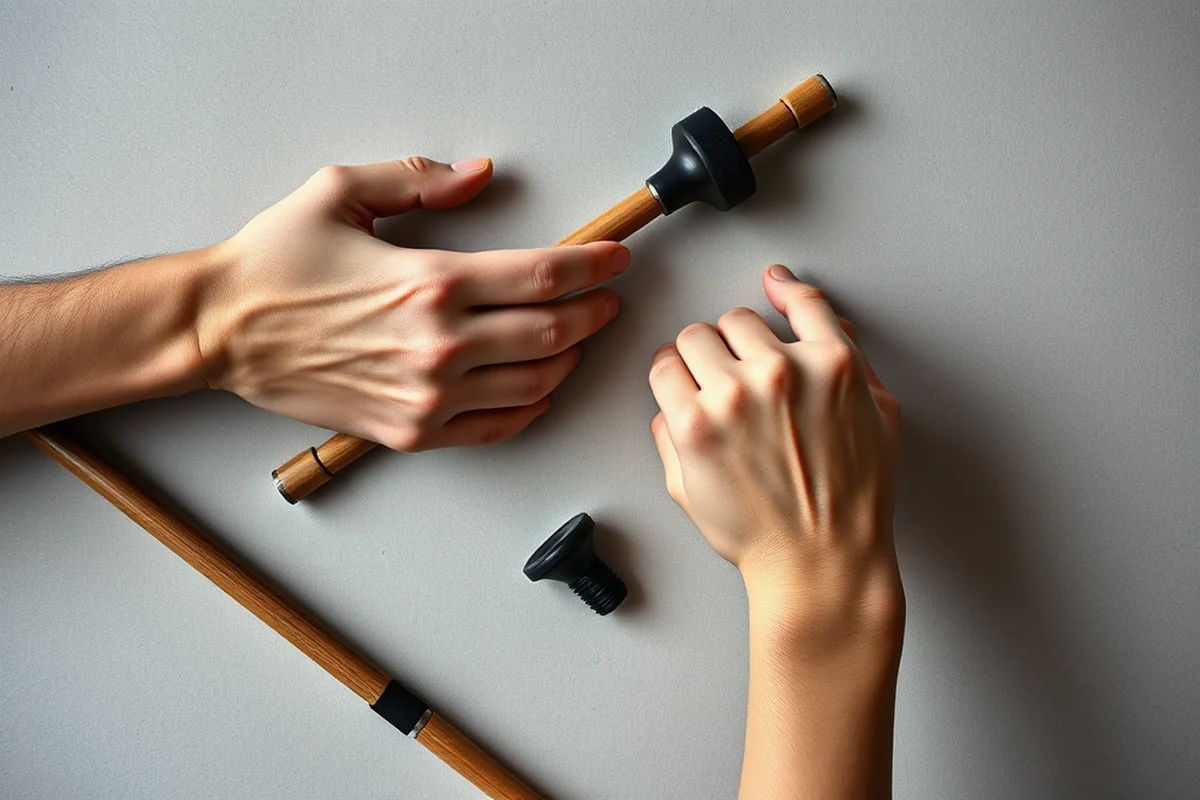
Not all walking sticks are created equal. Some are too thin and brittle, while others are too heavy and unwieldy. I’ve tested several different sticks over the years, and I’ve found that a good walking stick for fighting should be around 30–36 inches long and have a diameter of about 1 inch. This provides enough weight to make your strikes impactful, but not so much that it becomes a burden to carry.[2]
Material is also important. Sticks made from hardwood, such as ash or oak, are stronger and more durable than those made from plastic or bamboo. I once used a plastic stick in a training session, and it broke under pressure—something I wouldn’t want to happen in a real situation. Hardwood sticks are more reliable and less likely to snap during a fight.
I also recommend a walking stick with a slightly thicker handle, as this gives you better control and grip. Some sticks have rubber grips or other textures that improve traction, which can be especially useful in wet or slippery conditions.[3]
A good walking stick is like a good sword—it’s not about the size, but the balance.
Related: 10 walking techniques
The Five Key Techniques in Walking Stick Fighting
The first technique is the straight thrust. This is a simple but effective way to keep an attacker at bay. You extend your arm forward with the stick, aiming for the attacker’s face or chest. This move is best used when you’re trying to create distance or push the attacker away. I’ve used this technique in training sessions, and it works especially well when combined with verbal commands like 'Stop!' or 'Leave me alone!'
The second technique is the diagonal strike. This involves moving the stick in a diagonal motion from your body to the attacker’s. It’s great for targeting the sides of the attacker’s head or body, and it can be used to create openings for other techniques. I find this move particularly useful for beginners, as it’s easy to execute and doesn’t require much power.
The third technique is the block. This is used when defending against an incoming strike. You position the stick in front of your body, using it to absorb the impact and redirect the attacker’s force. This technique requires a lot of practice, but once you get the hang of it, it becomes second nature.
Dedicate time each day to practicing the five key techniques. This will help you build muscle memory and improve your overall skill level.
“I still remember the first time I found myself in a situation where I needed to use a walking stick for self-defense.”— Back Friendly Walking Techniques editors
Related: Techniques in walking
Using Your Body as a Weapon with a Walking Stick
One of the most important things to remember is that your body is your greatest asset. Even with a walking stick, you can use your legs, arms, and torso to control the situation. For example, if an attacker gets too close, you can step back, pivot on your foot, or use your body weight to push them away. I’ve found that combining body movement with the stick is more effective than relying solely on the stick.
Another useful technique is the low block. This involves using the stick to block a low strike, such as a kick aimed at your legs. By moving your body slightly to the side, you can absorb the impact and use the stick to push the attacker away. This technique requires good balance and coordination, but it can be very effective in a real fight.
I also recommend practicing footwork with your walking stick. Moving your feet in a way that keeps you balanced and ready to strike or block is essential. I’ve trained with a martial arts instructor who emphasized that footwork is just as important as the actual striking techniques. A well-placed step can make all the difference in a confrontation.[4]
Related: Techniques for walking
Defensive Positions and Stances
One of the most important defensive positions is the guard stance. In this stance, you hold the walking stick in front of your body, with your arms slightly bent. This allows you to react quickly to incoming attacks and gives you a solid base for striking. I find that this stance is especially useful when dealing with multiple attackers or when you need to be ready for any sudden movement.
Another useful stance is the low guard, where the stick is held lower to protect your legs and torso. This is ideal when you expect a low strike or a kick. I used this stance in a training session where I was defending against an attacker who was trying to kick me in the shins. It worked well, as I was able to block the attack and counter quickly.
I also recommend practicing the open stance, where you stand with your feet shoulder-width apart and your body facing forward. This gives you maximum mobility and allows you to move in any direction. This stance is great for beginners, as it’s easy to maintain and provides a good foundation for more advanced techniques.[5]
Related: Efficient walking techniques
Real-World Applications and Scenarios
One of the most common scenarios is defending yourself against an attacker in a public place, such as a park or a street. In these situations, the goal is to de-escalate the situation as much as possible, but if that fails, you need to be ready to use your walking stick. I’ve trained in simulated scenarios where I had to defend myself against a single attacker. I found that the key was to stay calm, use the right techniques, and try to create distance.
Another scenario is when you’re walking through a remote area, such as a trail or a forest. In these situations, you may not have access to other forms of self-defense, so having a walking stick can be invaluable. I once went on a hiking trip with a friend, and we both carried walking sticks. It was reassuring to know that we had a tool that could help us defend ourselves if needed.
I also recommend practicing in different environments, such as on uneven ground or in low-light conditions. This will help you become more comfortable with using your walking stick in any situation. I’ve trained in both daylight and low-light conditions, and I found that the techniques I learned were just as effective in both.
A walking stick is not just for walking—it’s a tool that can save your life.
Related: Best walking techniques
The Importance of Practice and Repetition
Like any form of self-defense, mastery of walking stick fighting requires time, effort, and repetition. I’ve found that practicing regularly, even for just a few minutes each day, can make a big difference in your skill level. It’s not about how much time you spend practicing, but about how consistently you do it.
One of the best ways to practice is by setting up a training area in your home or yard. You can use targets, such as pads or balloons, to simulate an attacker. I set up a small training area in my backyard, and I practice my techniques there every day. It’s a great way to get comfortable with the movements and build confidence.
I also recommend practicing with a partner, if possible. This allows you to simulate real-world scenarios and learn how to react to different types of attacks. I’ve trained with a few friends who are interested in self-defense, and it’s been a great experience. We take turns attacking and defending, which helps us improve our skills together.
🚶♂️ Beginner
Start with basic techniques and simple training sessions. Focus on grip, stance, and defensive moves.
💰 Budget
Use a low-cost walking stick and practice in your home or a safe outdoor area. No expensive equipment needed.
⏱️ Fastest
Practice short, high-intensity sessions that focus on speed and precision. Ideal for those with limited time.
🎖️ Advanced
Master complex techniques, sparring with partners, and scenario-based training for real-world application.
🛠️ Maintenance
Regularly check and sharpen your walking stick. Practice consistently to maintain your skills.
| The mistake | Why it happens | The fix |
|---|---|---|
| Using a weak or flexible walking stick | A weak stick can break during a fight, leaving you defenseless and increasing the risk of injury. | Choose a sturdy walking stick made from hardwood, such as ash or oak, to ensure it can withstand the force of an attack. |
| Not practicing regularly | Without regular practice, your techniques may not be effective in a real situation, and you may not be able to react quickly. | Dedicate at least 10 minutes each day to practicing your techniques. This will help you build muscle memory and improve your overall skill level. |
| Overrelying on the stick and not using body movement | Depending solely on the stick can leave you vulnerable if the stick breaks or is disarmed. | Combine body movement with your stick techniques to create a more effective defense strategy. Practice footwork and stance changes regularly. |
| Trying to use the stick in a way it wasn't intended for | Using the stick for things like hitting or prying can damage it and may not be legal in some situations. | Only use the stick for defensive purposes and avoid using it in a way that could be considered offensive or illegal. |
Walking Stick Fighting Techniques
Common Questions
Can I use a regular walking stick for self-defense?
How long does it take to learn walking stick fighting techniques?
Is walking stick fighting suitable for beginners?
What should I do if I'm facing multiple attackers?
References
- (PDF) Minoan stick fighting (1) - Academia.edu (academia.edu)
- Using Fire Management to See How Ticks…Tick | BNL Newsroom (bnl.gov)
- Leisure Life - Cookeville, TN (cookeville-tn.gov)
- rec.martial-arts FAQ - Part 3 of 3 (cs.cmu.edu)
- Filipino Martial Arts and Decolonial Praxis (digital.lib.washington.edu)
Cite this guide
Back Friendly Walking Techniques (2026). Walking Stick Fighting Techniques. https://walkspine.com/walking-stick-fighting-techniques/
Feel free to cite or share this guide.